Same Index, Different Tax Bill: What ETF Domicile Actually Costs You
Two ETFs can track the exact same index, hold the exact same companies, and still hand you a completely different tax bill on the dividends. The only difference is where the fund itself is legally based. Singapore has no tax treaty with the US, which makes this a bigger deal here than it sounds. Here's what fund domicile actually means, and how to check it yourself.
Last updated September 2026 · 8 min read · General information, not tax or investment advice, see the note below
If you've bought a US-listed ETF, something tracking the S&P 500 through a Singapore brokerage, there's a good chance you've never noticed this happening, and that's really the point of this article. Every time that fund pays a dividend, part of it gets withheld before it ever reaches you. There's no notification about it and nothing on your statement calling it out by name. It just quietly disappears at source. If you're based in Singapore, that withholding sits at 30% of the dividend, and it applies every single time, for as long as you hold the fund.
Now here's the strange part. There's often a version of the exact same underlying index, usually built by a different provider and listed on a different exchange, where that same dividend only loses 15% instead of 30%. Same index. Same companies underneath it. Same investment strategy, really. Yet somehow you keep twice as much of the dividend. The reason has nothing to do with what the fund actually invests in. It comes down entirely to where the fund itself is legally domiciled.
US-Domiciled ETF
No US/Singapore tax treaty
Ireland-Domiciled ETF
Reduced by US/Ireland treaty
Check the ISIN
IE = Ireland, US = United States
Same fund, different bill
Picture $100 in dividends coming from the same basket of US companies, flowing through two different funds that both track the S&P 500. One fund happens to be domiciled in the United States. The other is domiciled in Ireland, set up as what's called a UCITS fund, a common European structure, even though it holds exactly the same US stocks as the first one.
Both funds hold the same stocks and receive the same dividend from the same US companies. The whole gap comes down to the withholding rate applied at the fund level, before you ever see a cent of it, and that rate is set by where the fund is domiciled rather than where you happen to live.
Fifteen percentage points doesn't sound like much when you read it in one sentence like that. But it repeats. Every single payout, for as long as you hold that fund, whether that's a few years or a few decades, that same gap gets reapplied quietly in the background.
Why Singapore pays the full rate
That 30% figure isn't something everyone pays. It's the standard US withholding rate that kicks in specifically when there's no tax treaty between the US and wherever the investor actually lives to bring it down. A number of countries have negotiated treaties with the US that reduce this rate for their own residents. Singapore is not one of them, so if you're based here and holding a US-domiciled fund, you're paying the full, unreduced 30% every time. There's no form you can fill in and no paperwork that changes that.
So if your own residency can't change the rate, what can? The fund's own residency, in a sense. Ireland has a tax treaty with the US that brings withholding on US-sourced dividends down to 15% for Irish entities, and that includes Irish-domiciled funds. You don't personally claim any treaty benefit when you buy an Ireland-domiciled ETF. The fund itself already receives its dividends at that lower 15% rate, and whatever it saves gets passed along to everyone who holds units in it, no matter where those individual investors happen to live. Ireland doesn't add any further tax on top when the fund pays out to you. The whole saving happens once, at the fund level, before your share of the money is even worked out.
Worth being precise here though. This 15% advantage applies to dividends sourced from the US specifically. If an Ireland-domiciled fund instead holds European or Asian stocks, those dividends fall under whatever withholding rules those particular countries apply, and those rules vary quite a bit, sometimes less favourably. So really, this is a story about US dividends specifically, and it doesn't automatically carry over to every market a fund might invest in.
Sign in to keep reading
The rest of this article is free once you're signed in, no credit card, just an account.
You don't need to take anyone's word for this, ours included. It takes under a minute to check for yourself, for any fund you already hold or are thinking about buying, using information that's public for every single fund out there.
The quickest way in is the fund's ISIN, short for International Securities Identification Number, a code that every listed fund carries. The first two letters tell you where the fund is registered, which is a different thing from which exchange it happens to trade on. If the ISIN starts with IE, the fund is domiciled in Ireland. If it starts with US, it's domiciled in the United States. You'll also come across LU quite often, for Luxembourg, another popular European base for funds. That one's worth knowing about too, because Luxembourg's own tax treaty with the US isn't as generous as Ireland's, so a Luxembourg-domiciled fund usually doesn't get that same reduced rate.
None of this is about which fund is safer or riskier. Three funds could all be tracking the exact same US index and still land in any of these three boxes, and only one of those boxes actually passes along the reduced treaty rate.
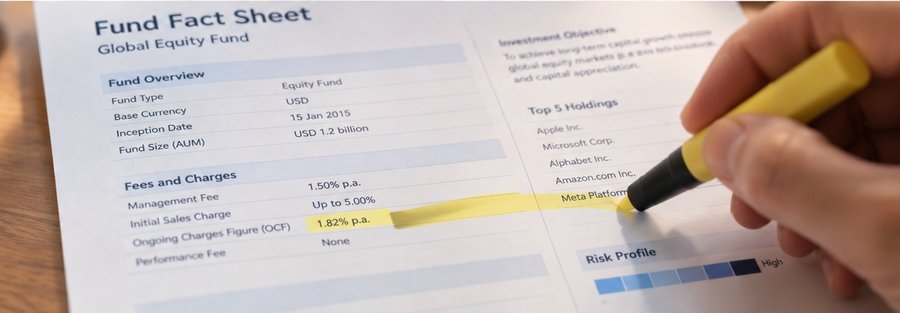
Beyond the ISIN, every fund also publishes a factsheet. It's usually just a single PDF, updated every month, and it sits freely on the fund provider's own website for anyone to read. It states the domicile in plain words, right near the top. Your broker's own fund page will often show the same thing. None of this is hidden or paywalled. It's built to be public.
What this is worth in real dollars
How much this actually costs you comes down to two things: how much of your money sits in dividend-paying assets, and what that fund's dividend yield actually is. It's genuinely worth running the numbers yourself here. The honest answer is that it depends, and there isn't one fixed dollar figure that applies to everybody reading this.
Here's a worked example, just to make the shape of it concrete, not a suggestion about what you should hold. A broad US equity ETF might pay out somewhere around 1.5% to 2% a year in dividends. Say you have a hypothetical $50,000 sitting in a fund yielding 1.5%. That works out to $750 a year in dividends. At 30% withholding, $225 of that never makes it to you. At 15%, it's $112.50. The gap on this one example, a bit over $112 a year, won't change anyone's life on its own. But it comes back every single year you hold the position, and it grows in direct proportion to how much you're holding and how high the yield is. Put more money in, or pick a higher-yielding fund, and the gap gets correspondingly bigger.
Funds built around growth rather than dividends barely feel any of this, simply because there isn't much dividend income for the withholding rate to bite into in the first place. Where this actually matters is for anyone holding dividend-focused funds, REITs, or income ETFs specifically, since the yield is higher there, and so is the drag.
What this isn't a reason to do
Once you've seen this gap laid out, the instinct is to want to sell whatever US-domiciled fund you already own and buy the Ireland-domiciled version instead right away. Worth slowing down before doing that though, because selling isn't free, and the whole thing only actually makes sense if switching costs you less than the withholding gap saves you.
Selling has its own transaction costs, and if your position has gone up since you bought it, there may be a capital gain to think about too, which comes down to your own tax residency and isn't something a general article like this one can answer for you.
The saving scales with yield and how long you hold. A small position, a short remaining holding period, or a low-yielding fund can all shrink the actual benefit down to less than what switching would cost.
This is only one factor among several. Expense ratio, how easily the fund trades, what currency the units are in, and what's even available through your particular broker all matter too, and any of them can point you in a different direction than domicile alone would.
None of that means the gap isn't worth knowing about either. It's genuinely useful information to have before your next purchase, since at that point there's no switching cost involved at all. You're simply picking which version of an index to buy for the first time.
A simple framework
Rather than one answer that's supposed to fit everyone, here are three questions worth asking yourself honestly, roughly in this order.
Am I buying fresh, or do I already hold something? If you're about to buy for the first time, checking domicile costs you nothing. There's no switching cost to weigh it against. If you already hold a US-domiciled fund, the question gets more complicated, which is exactly what the next two are about.
How much of my return is actually coming from dividends? If your holding is growth-heavy with a low yield, there isn't much at stake here. If it's dividend-focused or income-oriented, there's a lot more riding on it.
What would actually switching cost me, once transaction fees and any capital gains are factored in? Once you know that real number, you can honestly weigh it against the withholding saving using your own position size and yield, the way the earlier section walked through, rather than someone else's example.
This article was never trying to tell you which fund to hold. The point is simpler than that. Which country a fund is domiciled in is a real, checkable fact that quietly shapes your actual return, and it's worth knowing how to look that up before your next purchase, rather than stumbling onto it by accident years down the line.
Track your holdings, currency and all, in one place
WealthVault SG lets you record USD-denominated holdings and converts them to SGD automatically, so your real net worth stays accurate.
This article is for general information only, not financial, investment, or tax advice. Withholding tax rates, treaty terms, and fund structures can change, and your own personal tax treatment depends on your specific circumstances and country of tax residency. Verify current details directly with a fund's own factsheet or provider, and consider speaking with a licensed financial or tax adviser before making any decision based on this information.
Guides are temporarily unavailable
Check back soon, or explore our free calculators instead.