Physical vs Paper Gold in Singapore: What Each One Really Costs
A bar, a coin, an ETF, a bank gold account and a 999 bangle all follow the same gold price. They don't cost the same to own. Here's what each one costs in Singapore, what you own with each, how CPF and SRS fit in, and how to choose between them.
Last updated October 2026 · 9 min read · General information, not tax or investment advice, see the note below
Say you've decided a little gold belongs in your portfolio. In Singapore, that still leaves you choosing between a bar in a drawer, a coin in a vault, a few shares of an ETF, a gold account at your bank, or a 999 bangle from the shop downstairs. They all go up and down with the same gold price. They do not cost the same to own, and most of the difference never appears on a price tag.
This is the second half of our look at gold. Part one covered what moves the price and whether gold deserves a place at all. This part is about the practical question that comes next: if you're going to hold it, which form costs you least, and what are you getting?
No GST on investment gold
Qualifying bars and coins only
Buy-sell gap: 2% to 21%
Smaller pieces cost far more
About 0.4% a year
Headline ETF fee or vault rate
Physical gold: what you pay
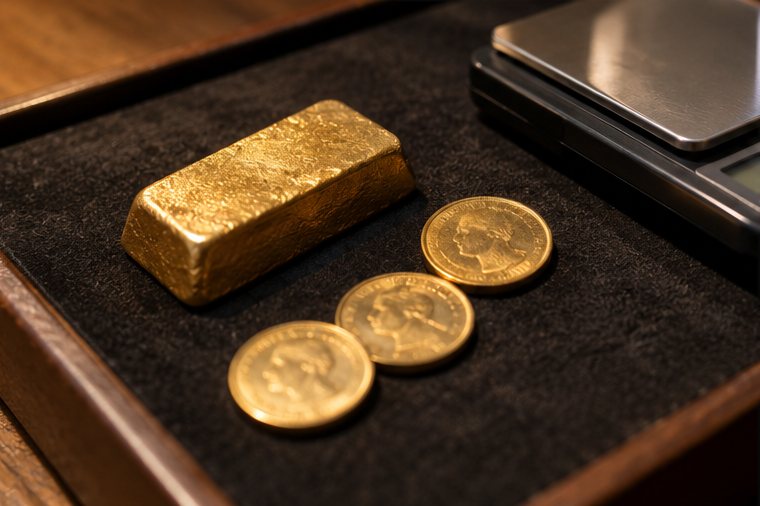
Singapore doesn't charge GST on investment-grade gold, and hasn't since October 2012. To qualify, a bar has to be at least 99.5% pure and come from a refiner that is, or has been, on the London bullion market's approved list. A specific list of coins qualifies too, including the Canadian Maple Leaf, the British Britannia, the Australian Kangaroo, the Austrian Philharmonic and Singapore's own Lion. Anything else, including jewellery, carries the usual 9%.
The main cost of physical gold is the gap between what a dealer sells for and what the same dealer will pay to buy it back. You pay that gap in full the moment you walk out of the shop. This is what it looked like at UOB, the only bank here that sells physical gold, on the evening of 2 October 2026.
Gap between the selling and buy-back price, by size
1 g bar21.1%
10 g bar8.8%
1 oz coin4.3%
50 g bar2.8%
100 g bar2.2%
1 kg bar1.7%
UOB's published prices on 2 October 2026: for example, a 100 g cast bar sold at S$17,458 and was bought back at S$17,082. Prices move through the day, but the pattern doesn't. The gap is shown as a share of the selling price. At BullionStar the same evening, the gap on a single piece was about 4.0% on a 1 oz Maple Leaf, 3.3% to 3.8% on a 100 g bar depending on the brand, and about 2.5% on a 1 kg bar, with slightly less on larger orders. Its own-brand 100 g bar, sold as "no spread", was about 1% for a single bar.
A one-gram bar makes a sweet gift and a costly investment: you're down a fifth as soon as you buy it, and gold has to rise by more than a quarter before you break even. Bigger pieces are far cheaper per gram, but a 100 g bar is a S$17,000 purchase, which isn't how most people start.
Then there's where to keep it. At home costs nothing and insures badly: one major insurer's home policy caps jewellery and other valuables at S$1,000 or S$2,000 per item, depending on the plan. A safe deposit box runs from about S$159 to S$819 a year at Certis, before GST and if you pay by GIRO, and neither Certis nor the banks take responsibility for insuring what's inside. A dealer's vault is the other route. BullionStar charges 0.39% a year and Silver Bullion 0.35%, and both say the metal they store is insured.
One practical catch: UOB only buys back gold that was originally bought from UOB. It asks for the purchase invoice and an unbroken seal, and for gold bought since March 2025 the seller has to be a UOB account holder. How easily a bar sells depends on who will take it, so it pays to keep the receipt and the original packaging.
Sign in to keep reading
The rest of this article is free once you're signed in, no credit card, just an account.
"Paper gold" gets used as if it were one product. It's at least three, and what you legally own is different in each.
Gold ETFs. You buy units on the Singapore Exchange through any brokerage account, and the fund holds the bars. The best known is SPDR Gold Shares, which trades in US dollars (ticker O87) and Singapore dollars (GSD), costs 0.40% a year, and was about S$486 a share in late September. Since March 2026 there's also the LionGlobal Singapore Physical Gold ETF (GLS in Singapore dollars, GLU in US dollars), with a 0.39% management fee, gold vaulted in Singapore, and a much smaller unit price. You own a share of a fund that owns gold. You can sell in seconds during market hours, but you can't turn up and ask for a bar.
Bank gold accounts. UOB's Gold Savings Account lets you buy from 5 grams, with a gap of about 1.6% between its buying and selling price on 2 October and a service charge of 0.25% a year. You can convert your balance into 100 g bars for S$100 each. OCBC's Precious Metals Account starts from a hundredth of an ounce with no custody fee, but its terms are blunt: you have no right to physical delivery, and no ownership interest in any metal the bank holds.
A bank gold account, in other words, is the bank's promise to pay you the value of the gold. That is a claim on the bank, which is a different thing from owning metal, and both UOB and OCBC state that these accounts are not covered by Singapore's deposit insurance scheme.
Apps. Some investing apps now offer gold exposure in tiny amounts. Revolut, for example, charges 0.99% per order on its standard plan, with a S$1.49 minimum, on top of the market spread. Convenient for small sums, but the fee applies to every order, so it adds up if you buy often.
What S$10,000 of gold costs you over five years
To compare them fairly, take S$10,000, hold it for five years, then sell. Assume the gold price doesn't move at all, so that everything you lose is cost. Using the prices and fees published on 2 October 2026:
Total cost over five years on S$10,000
Gold ETF~S$270
UOB gold account~S$295
A 50 g bar or 1 oz coins at home~S$355
Bars or coins in BullionStar's vault~S$735
ETF: 0.275% brokerage with a S$25 minimum each way, exchange fees and GST (about S$70), plus 0.40% a year in fund fees (S$200); the small gap between the ETF's own buying and selling price is left out. UOB account: 1.58% spread (S$158) plus 0.25% a year and GST (S$136). At home: a dealer gap from 2.8% on UOB's 50 g bar to 4.3% on its 1 oz coins (S$280 to S$430), uninsured. Vault: BullionStar's own 50 g bar or 1 oz coins at a gap of 3.8% to 4.0% (S$380 to S$400), plus its S$0.19 a day minimum storage fee (S$347). Other brokers, dealers and vaults charge differently, and prices change, so treat these as a snapshot.
On these numbers, the cheapest bar is level with paper, and other small pieces cost more. An ETF or a bank account costs roughly 2.7% to 3% over five years. So does a single 50 g bar from UOB kept at home. One-ounce coins and smaller bars cost a good deal more, before you've paid for anywhere to put them.
Vault storage punishes small holdings. The headline 0.39% only applies above roughly S$18,000. Below that, the daily minimum takes over, and on S$10,000 it nearly doubles your total cost.
Time flips the answer. A bar's cost is paid once. An ETF's fee is paid every year. Hold for longer than about five to nine years, depending on the piece, and gold kept at home works out cheaper than an ETF, as long as you're comfortable being your own security guard.
Using CPF or SRS
You can buy gold with your CPF Ordinary Account, within tight limits. Only savings above the first S$20,000 in your OA can be invested, and gold is capped at 10% of your investible savings, which CPF defines as your OA balance plus anything you've already withdrawn for investment and education. Special Account money can't be used for gold at all.
What you can buy is narrow too. CPF's product list, last updated in February 2026, names SPDR Gold Shares as the only gold ETF included. Other gold products are available through UOB, including its Gold Savings Account, which costs an extra 3 cents a gram when bought with CPF and can't be converted to physical bars.
The comparison is with what that money earns if it's left alone. Your OA pays 2.5% a year, guaranteed, in Singapore dollars. Gold pays no interest and fell 22% between its January record and early October, as part one covered, so it has to rise by more than 2.5% a year just to match leaving the money where it is.
SRS is more straightforward. SRS money can buy ETFs listed on the Singapore Exchange, and SPDR Gold Shares has been among the ETFs most held by SRS investors. LionGlobal says its gold ETF accepts SRS too.
Jewellery is not investment gold
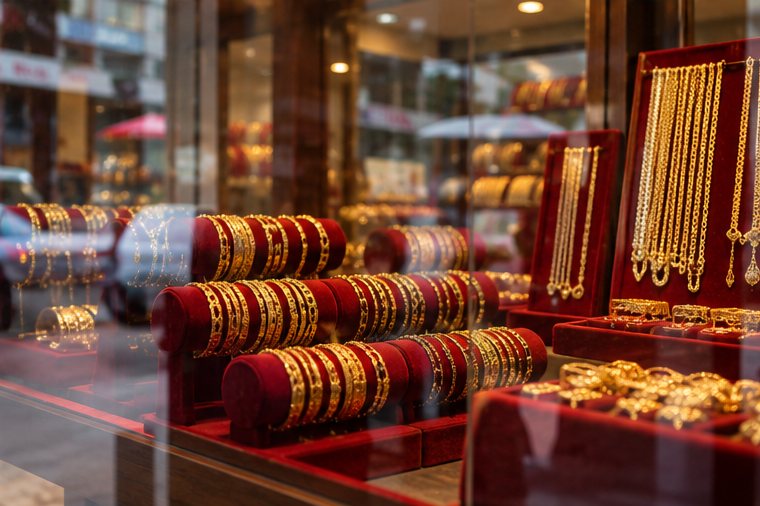
This one matters most in the weeks before Deepavali and Chinese New Year. At the start of October 2026, jewellers' list prices for 999 gold (99.9% pure) ranged from about S$223 to S$242 a gram. The metal itself was worth about S$172. That's 30% to 41% above the gold value, usually before any workmanship charge. Jewellery also carries GST, which investment bars and coins don't.
Selling it back is worse. One shop that publishes both prices listed 999 gold at S$224 a gram on 1 October and would buy it back for S$162 in cash, about 94% of the metal value, or S$184 if you traded it in for another piece. Buy a bangle at S$224 a gram and sell it for S$162, and you're down 28% on the gold alone. Jewellery is lovely to wear and to give. As a way of holding gold, it is the most expensive one in this article.
What can go wrong
Schemes that promise a return on gold. Gold pays no income, so anyone guaranteeing you monthly payouts or a fixed buy-back price is getting that money from somewhere else. MAS has said since 2012 that it does not regulate schemes where investors buy physical assets like gold directly. Genneva, a gold trading company, was placed on its Investor Alert List in 2011. The Gold Label, a buy-back scheme that took in about S$150 million from more than 2,000 customers, ended with its directors jailed in 2022.
Keeping a lot at home. Check your home insurance for the limit on valuables before you assume you're covered.
Buying something you can't easily sell. Odd brands, damaged packaging and non-qualifying coins all sell at a discount.
Tax surprises. Singapore doesn't tax capital gains, so a profit on gold you held as an investment is generally not taxed. Frequent buying and selling can be treated as a trade, though, with the profit taxed as income. If that might be you, check with IRAS.
How to choose
The best way to hold gold depends on how much, for how long and why. Five questions cover most of it.
How much am I putting in? For a few thousand dollars, or regular small amounts, an ETF or a bank gold account avoids the heavy cost of small bars.
How long will I hold it? On the costs above, shorter periods favour paper. A decade or more, in larger amounts, starts to favour bars.
Do I want it outside the financial system? If the whole point is to own something that doesn't depend on a bank or a fund, only physical gold does that, and you'll pay for the privilege.
Am I using CPF or SRS? Then the eligible options are narrower: a gold ETF listed on the Singapore Exchange, or for CPF, the gold products on CPF's approved list, within the limits above.
Do I just want something beautiful? Then it's a purchase to enjoy, and it sits outside your investment sums.
Nobody controls the gold price. The cost of holding it is the part you can choose, and on S$10,000 over five years the gap between the cheapest and dearest route above was more than S$450.
See your gold next to everything else you own
Add gold as an asset in WealthVault SG and track it alongside your CPF, cash and investments.
This article is for general information only, not financial, investment, or tax advice, and it is not a recommendation to buy or sell gold or any product named. Prices, spreads and fees are as published by the providers between late September and 2 October 2026 and change frequently; scheme rules can change too. Check current prices and terms with the provider, and CPF and SRS rules at cpf.gov.sg and iras.gov.sg, before you buy. Consider speaking with a licensed financial adviser before making an investment decision.
Guides are temporarily unavailable
Check back soon, or explore our free calculators instead.